
Extra-large dog harness
Large-dog harness pages tend to talk about strength of materials. The more useful question is geometry: on a big dog, the direction of the force decides whether you stay upright.
Why the attachment point matters more as the dog gets bigger
Force scales with the dog. A 6 kg terrier leaning into a harness is an annoyance; a 40 kg shepherd doing the same thing is a fall risk on a wet pavement. The mechanics do not change with size, but the consequences do.
16.87 N vs 6.97 N — peak leash tension on a back-attachment harness versus a plain collar, across 52 dogs. The dogs also spent about twice as much of the walk pulling. (Shih et al., Frontiers in Veterinary Science 8:735680, 2021)
Note the weight range in that study: 16 to 43 kg. This is the one piece of research on our site that was measured on dogs the size of yours, and it found that a back-attachment harness produced more than double the peak leash tension of a plain collar. If you have been walking a large dog on a back-clip harness and wondering why it feels worse than the old collar did, that is not your imagination.
No significant difference — in pulling between a front-clip harness and a metal prong collar across 23 dogs; both beat a martingale at p = 0.001. (Johnson & Wynne, PeerJ 12:e18131, 2024)
The practical reading for a big-dog owner: a front-clip harness performed as well as a prong collar in that trial. If you have been considering a prong out of desperation, this is the finding to weigh first.
Sizes and what buyers actually fitted
| Harness | Largest size | Reaches |
|---|---|---|
| Front-clip harness | XL — 81–107 cm chest | Roughly 30–50 kg — and it keeps the chest attachment |
| Personalised vest | XXL — 75–101 cm chest | Rated to 60 kg, but back attachment only |
Buyer reports — two independent buyers fitted 35 kg Labradors into size L — a size the chart caps at 30 kg — and both reported adjustment left over. A 25 kg pitbull also fitted L. At the top end, one buyer with a 38 kg dog found XL loose, and another measured the XL maximum girth at 100 cm. One US buyer suggested sizing down, noting the back panel ran long for the stated weight. (verified buyer reviews)
The pattern is consistent enough to act on: the chart runs generous, so size by chest measurement and go down rather than up when you are between bands. That is the opposite of the usual advice for large dogs.
The hardware question, stated plainly
This matters more on a big dog than anywhere else on this site. Buyer reports disagree about the harness hardware.
Buyer reports — one buyer wrote that the rings are plastic and “one tug and they will break apart” — on an Amstaff in XL. Another described “plastic closures, metal hook on the chest and back”. A third said the top clip is plastic but the chest one is metal and well anchored. A fourth said all the snaps and rings were plastic. (verified buyer reviews)
Four buyers, two different accounts. For a dog over about 35 kg, use a double-ended leash clipped to both rings, so no single point carries the whole load. That is good practice on a powerful dog whatever the hardware is made of.
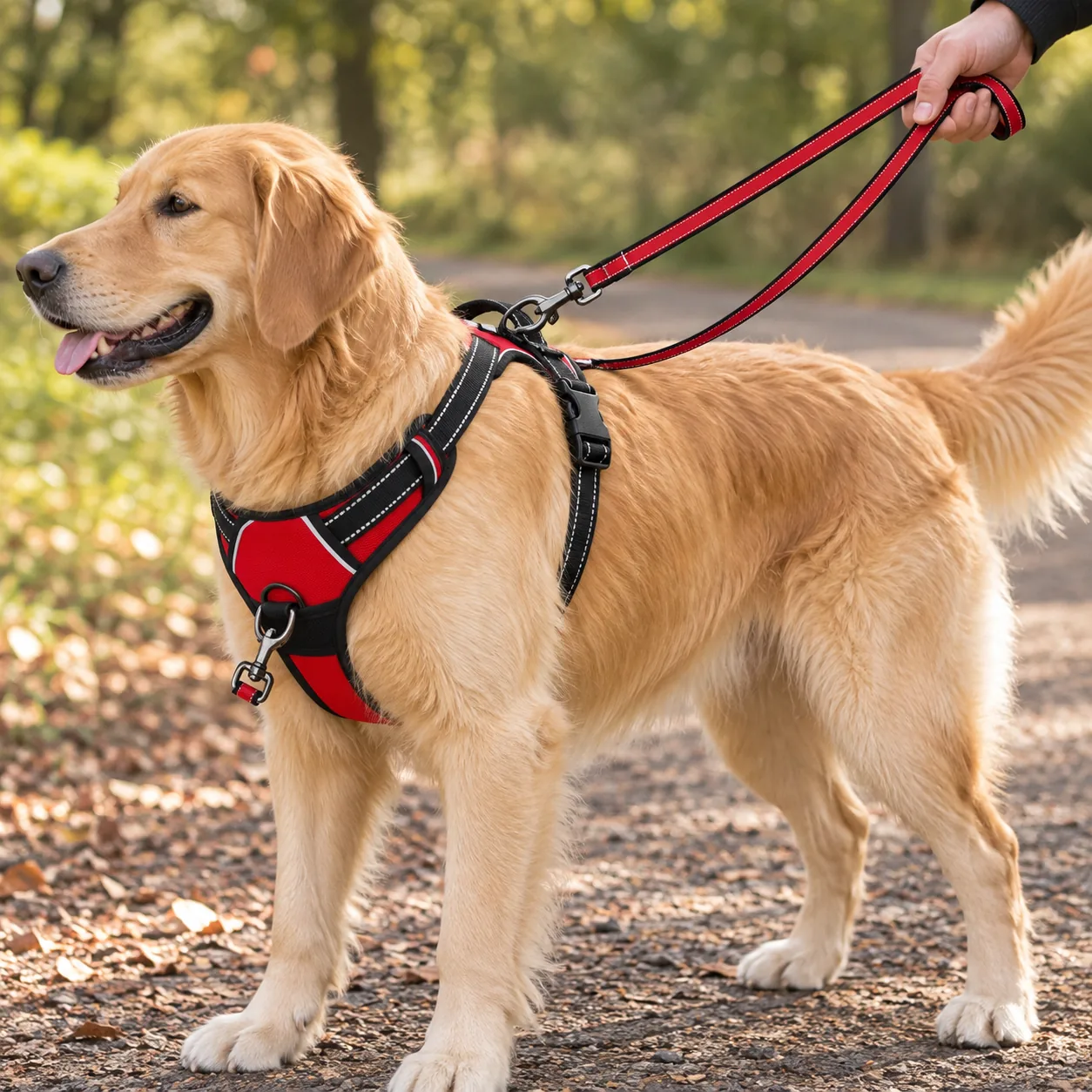
The buckles are plastic side-release, which is standard across this entire product category including the well-known brands.
Fitting an extra-large dog harness on a deep-chested dog
Large breeds are where the four adjustment points stop being a spec and start being necessary. A deep-chested dog — a shepherd, a boxer, a greyhound cross — has a ribcage that tapers sharply behind the front legs, so a harness set only at the girth will sit correctly on the ribs and slide forward onto the throat.
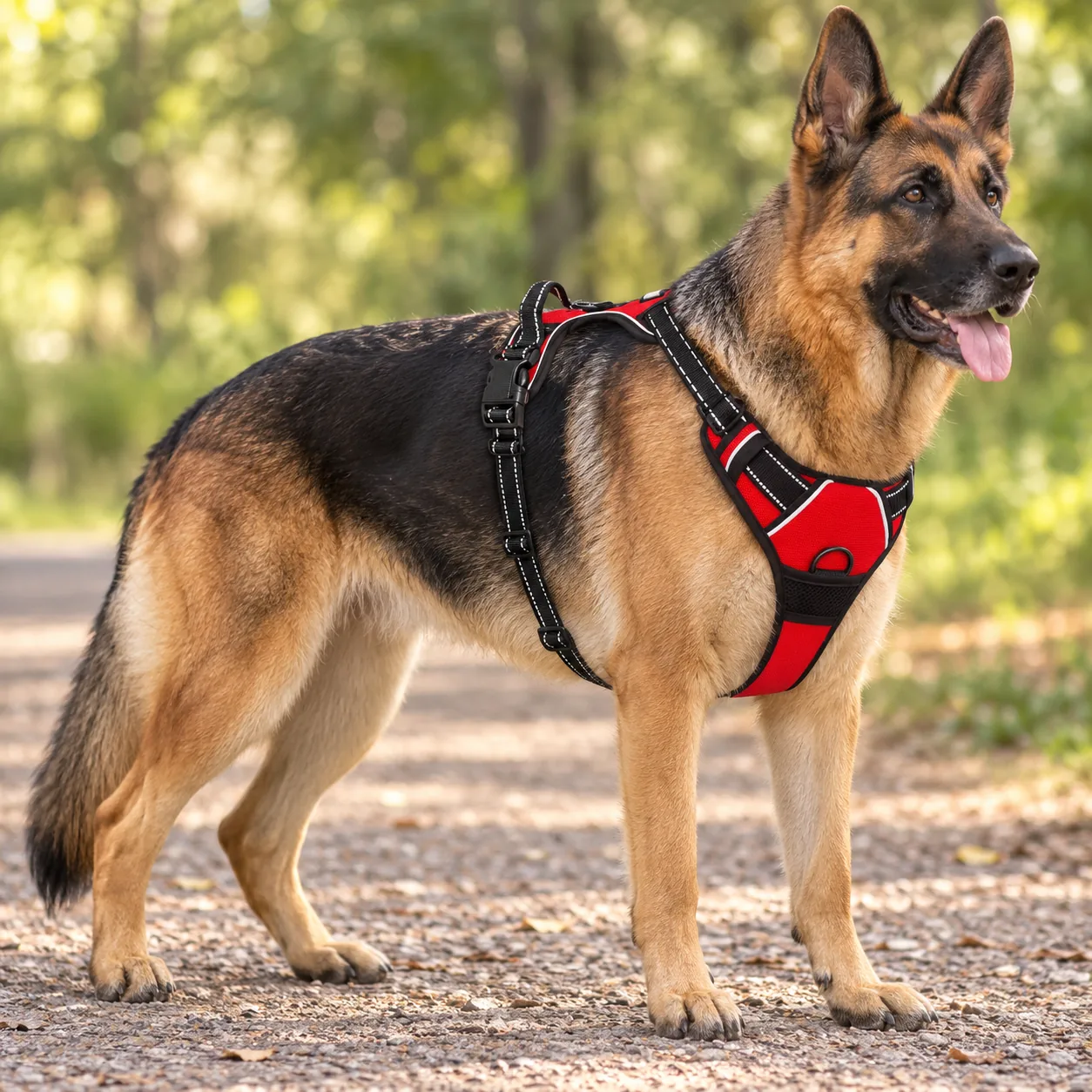
Set the girth strap first, snug enough for two flat fingers, then lengthen the neck straps until the chest panel drops onto the breastbone. If the panel sits high, you have the adjustment backwards. There is a fuller walkthrough on the fitting guide and measuring instructions on how to measure a dog.
What an extra-large dog harness will not do
It will not stop a dog that has learned that pulling works. It changes where the force goes and buys you the opportunity to reward a slack leash; the habit changes through repetition. There is more on that in training a dog to stop pulling and what makes a no-pull harness work.
It also will not make a harness escape-proof — see the escape-proof page — and the top handle is for steadying, not lifting, which we cover on the handle page. If your dog is under 16 kg, the small dog harness page is the right one.
Extra-large dog harness questions
What is the biggest dog this fits?
The front-clip harness runs to a 107 cm chest in XL, which covers roughly 30-50 kg. The personalised vest reaches a 101 cm chest in XXL and is rated to 60 kg, but it attaches at the back only. Measure the chest behind the front legs; the weight column is the least reliable part of any chart.
Is the hardware strong enough for a 40 kg dog?
Buyer reports split between metal and plastic at the chest ring, and one owner of an Amstaff reported the rings gave way. On a dog over 35 kg we recommend a double-ended leash on both rings so no single attachment carries the whole load.
My dog is 35 kg. Do I need XL or is L enough?
Two buyers fitted 35 kg Labradors into L with room to spare, even though the chart caps L at 30 kg. Measure the chest: if it is under 81 cm, L will fit. A 38 kg dog reported XL as loose, so going straight to XL on a 35 kg dog is likely to be too big.
Will a front-clip harness stop my large dog pulling me over?
It changes the direction of the force so a pull turns the dog rather than dragging you forward, which is a real mechanical advantage. It is not a guarantee on a very strong dog. If a front clip is not enough, a head halter steers more directly, though most dogs need a slow introduction before they accept one.