
The no-pull harness that clips at the chest
Most harnesses sold as “no-pull” attach on the back — and a 52-dog study found that makes dogs pull harder than a plain collar. Ours attaches at the chest, where the leash can actually turn a puller around.
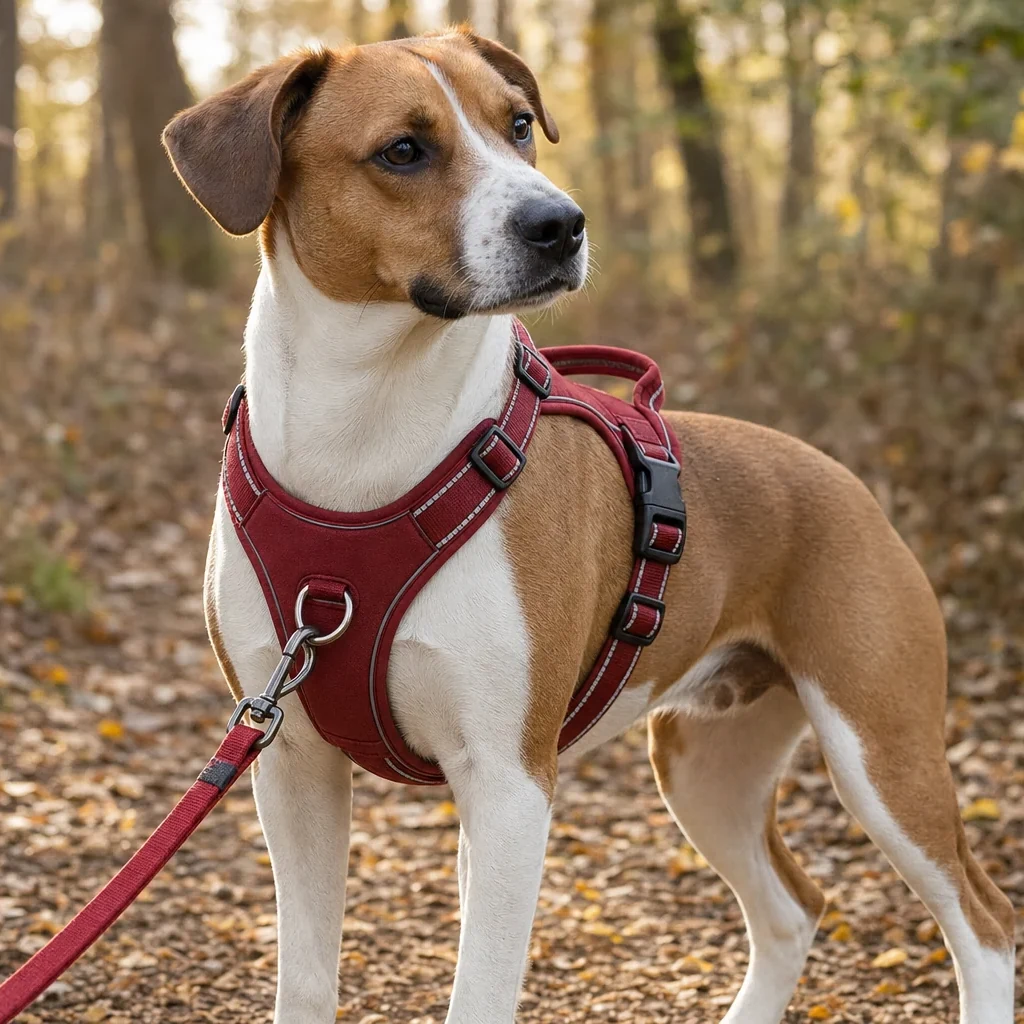
A back-clip harness can make pulling worse
It helps to picture what a dog is actually doing when it pulls. Body weight goes forward, the shoulders drop slightly, and the dog pushes against whatever is holding it back. That push has to land somewhere. When the leash runs to a ring sitting between the shoulder blades, it lands squarely across the chest and the dog gets exactly what a sled dog gets — a stable, comfortable point to drive against. Nothing about the harness says stop. The geometry says go.
This is not a matter of opinion. Shih and colleagues measured it in 2021 across 52 shelter dogs, comparing a neck collar against a back-connection harness. Maximum leash tension went from 6.97 newtons on the collar to 16.87 newtons on the back-clip harness. The dogs also spent roughly twice as much of the walk actively pulling. The researchers were careful about the limits of their own result — the effect showed up when dogs were working toward food and disappeared when the reward was a toy — but the direction was consistent, and it is the opposite of what most shoppers assume when they buy something labelled no-pull.
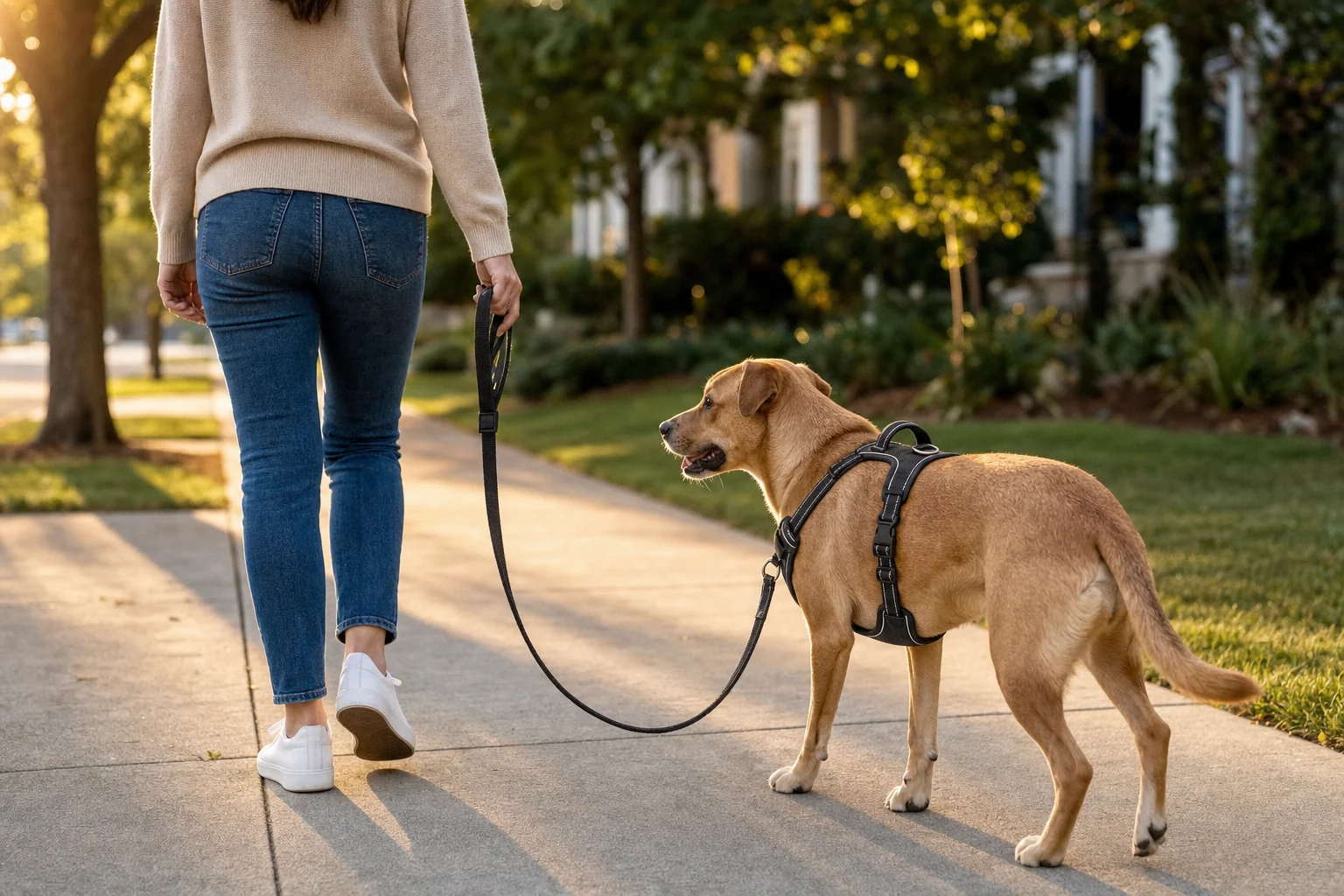
Move the ring to the chest and the mechanics invert. The leash now runs from a point ahead of the dog's centre of mass, so a hard pull rotates the body back toward the handler rather than loading straight into the harness. The dog does not get a wall to push against. It gets a gentle turn, which interrupts the behaviour long enough for you to reward the loose leash.
Johnson and Wynne put numbers on that in 2024. Across 23 dogs walking on four different setups, a front-connection harness produced significantly less pulling than a martingale collar. The finding worth pausing on is the one that came next: there was no significant difference between the front-clip harness and a metal prong collar. The gentlest option in the trial performed as well as the harshest one. That is the whole argument for a front clip, and it is why the harness on this page has a ring at the chest.
Three things that decide whether a no-pull harness works
A ring at the chest, not just the back
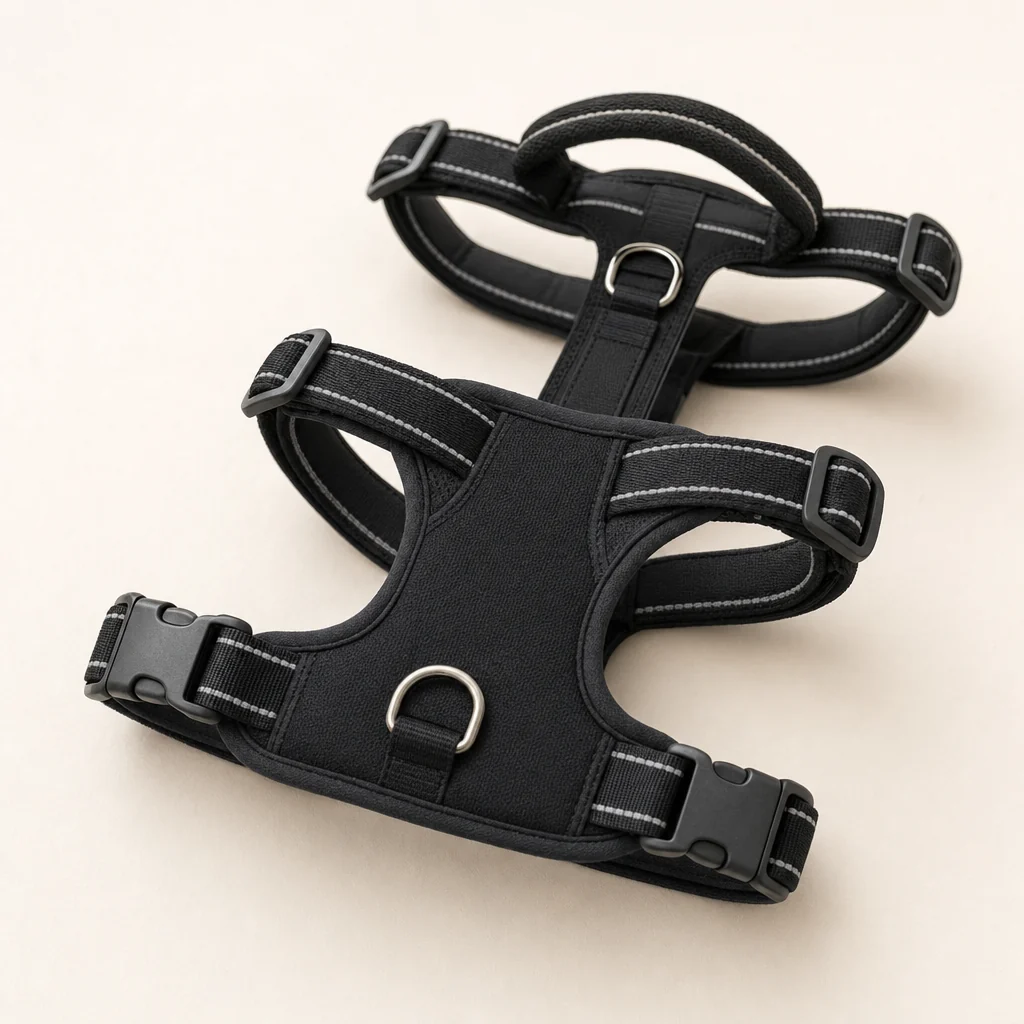
The chest D-ring is the working attachment. Clip the leash there and a pull rotates your dog back toward you instead of loading into the harness. The back ring stays useful for relaxed walks once the pulling stops.
Both attachment points are stitched onto reinforced webbing rather than fabric alone. Buyers describe the chest ring as well anchored, though their reports differ on whether it is metal or reinforced polymer — we say so plainly in the FAQ rather than guess.
Four adjustment points
Two straps at the neck, two at the girth. Four points let you set the chest panel so it sits in front of the shoulder rather than riding up the throat, which is where most fitting problems start.
A harness that only adjusts at the girth will fit the ribcage and miss the chest entirely. On deep-chested dogs, that is the difference between a harness that redirects and one that slides sideways on the first hard pull.
Reflective stitching on every strap
Reflective thread runs the length of the straps, not just a logo patch. It matters on the walk most owners actually do — the one after work, in the dark, along a road.
There is also a padded top handle sewn through the spine panel. It is for holding your dog steady at a kerb or a vet door, not for lifting a dog off the ground.
The size chart, and the dogs that actually fit each size
The chart runs generous. Two 35 kg Labradors fitted into a size L that the chart caps at 30 kg, both with adjustment to spare, and a 38 kg dog found XL loose. If your dog sits near the top of a size band, measure the chest rather than trusting the weight column.
| Size | Official chart | Fits reported by buyers |
|---|---|---|
| S | 43–56 cm chest · 3.6–6.8 kg | Small terriers, no fit complaints |
| M | 56–69 cm chest · 6.8–16 kg | 64 cm chest fitted with adjustment left over |
| L | 69–81 cm chest · 16–30 kg | 20 kg / 63 cm, 22 kg, 25 kg pitbull, and two 35 kg Labradors — the last two above the chart, both with room to spare |
| XL | 81–107 cm chest · 30–50 kg | 38 kg reported as loose; one buyer measured maximum girth at 100 cm |
The numbers behind our no-pull harness
peak leash tension on a back-clip harness, against 6.97 N on a plain collar — measured across 52 dogs
— Shih et al., Frontiers in Veterinary Science 8:735680, 2021
of owners report that their dog pulls on the lead
— Townsend et al., cited in Johnson & Wynne, PeerJ, 2024
in pulling between a front-clip harness and a metal prong collar across 23 dogs — the gentlest option matched the harshest
— Johnson & Wynne, PeerJ 12:e18131, 2024
Front clip, back clip, collar, head halter
| Setup | What it does when the dog pulls | Best for |
|---|---|---|
| Front-clip harness | Rotates the dog back toward the handler; measured to cut pulling significantly versus a martingale | Dogs that pull, and owners who want to train rather than restrain |
| Back-clip harness | Gives the dog a stable point to lean into; measured to increase leash tension versus a collar | Small dogs, relaxed walks, dogs that already walk on a loose leash |
| Flat or martingale collar | Loads force onto the neck; raises intraocular pressure under tension | Carrying ID tags. Not a pulling solution |
| Head halter | Steers the head directly; effective, but many dogs need a long desensitising period | Very strong dogs where a harness is not enough |
One honest caveat on the collar row: Pauli and colleagues (2006) found that pressure applied through a collar raised intraocular pressure across 51 eyes, while the same force through a harness did not. That is a reason to move away from collars for dogs that pull — not a reason to believe a harness fixes the behaviour on its own.
Dogs pulled harder and more steadily on the leash to reach food, but not toys, when the leash was connected to the back-connection harness compared to the neck collar.— Shih, Phillips, Mills, Yang, Georgiou & Paterson, Frontiers in Veterinary Science, 2021 — 52 dogs
Fitting and sizing a no-pull harness
How to measure your dog and pick a size
Measure the chest, not the dog. Run a soft tape around the widest part of the ribcage, just behind the front legs, and keep it snug without compressing the coat. Take the measurement three times and use the largest number — dogs move, and a tape that slips backward will read small. If your dog falls between two bands, the chart already runs generous, so the smaller size is usually the better fit rather than the larger one.
Fitting matters as much as sizing. The chest panel should sit in front of the shoulder joint, low on the breastbone, with the D-ring centred. If the panel creeps up toward the throat, the neck straps are too tight and the girth straps too loose — lengthen the top and shorten the bottom. You should be able to slide two flat fingers under any strap. A harness that passes the two-finger test everywhere but rides up on the first hard pull is not adjusted, it is just loose.
Give it a week before you judge it. A front attachment changes how the leash feels in your hand: the dog's weight arrives as a turn rather than a straight drag, and most owners over-correct at first. Keep the leash short enough that the line runs forward from the chest ring rather than sideways, and reward the moment the leash goes slack rather than the moment the dog stops. The equipment buys you the opportunity; the reward is what teaches the habit.
One thing a harness will not do is make an unfit dog fit. Grainger and colleagues (2016) found no measurable difference in stress behaviour between collar and harness walking across 30 dogs. The advantage of a front clip is mechanical, not emotional — it changes where the force goes, and that is all it claims to do.
Specifications
| Attachment points | Chest D-ring (working attachment) + back D-ring |
| Adjustment | 4 points — 2 neck, 2 girth |
| Sizes | S · M · L · XL (43–107 cm chest) |
| Closures | Two side-release buckles |
| Handle | Padded top handle, stitched through the spine panel |
| Reflectivity | Reflective thread along the full length of the straps |
| Shipping | Free across the United States · 30-day returns |
Chest ranges are flat-measured figures, with a stated tolerance of 1–2 cm.
Rated 4.7 / 5 across 1398 verified buyers
"Excellent product, the size is exactly as described on the page, it fits my dog perfectly since the length of the straps can be adjusted. 100% recommended, very satisfied with this product."
— G. A., verified buyer
"Perfect size, my pitbull weighs 25 kg and size L fit perfectly. He started pulling less during walks compared to when I used a leash before. Highly recommended."
— Bruno M., verified buyer
"Easy to adjust, my medium sized dog moves well with this on and it seems hard for him to pull it off. The construction is well made."
— Carla R., verified buyer
Three harnesses, and two of them clip at the chest
The research above makes the distinction concrete: a back-only attachment is the configuration Shih and colleagues measured pulling hardest on. That is why the no-pull label here belongs to the two harnesses with a chest ring, and not to the third.
So here is the split. Buy the front-clip harness if your dog leans into the leash, drags you toward other dogs, or has ever pulled you off balance. It has a chest ring, four adjustment points and a handle, and it is the harness this page is about.
Buy the personalised harness if your dog already walks reasonably well and what you actually want is a padded vest with your dog's name and your phone number printed across both sides. Buyers use it exactly that way — one owner called the patch “such a nice touch”, another confirmed the print came through correctly in Hebrew. The patch is removable and appears on both flanks. It comes in six sizes, from a 39 cm chest up to 101 cm, which is a wider span than the front-clip covers at either end.
And if you want the toughest build of the three — 1050D nylon, metal rings front and back, and a MOLLE panel that takes patches — that is the tactical harness. It carries a chest ring too, so it handles a puller as well as the front-clip does; it simply costs more because the build is heavier.
For a chest ring and a printed name at once, order both: a chest-ring harness for walks, the vest for identification.
Which harness for which dog
Small dogs and toy breeds. Under a 56 cm chest, the front-clip harness only starts at size S and a lot of small dogs sit below its floor. The personalised vest starts at a 39 cm chest, which reaches dogs of 3 kg — two separate buyers fitted 3 kg and 4 kg dogs into size S and reported a good fit. We go through the trade-offs on the small dog harness page.
Large and powerful dogs. This is where the chest ring earns its place, because this is where a pulling dog can genuinely move you. Buyers have fitted 35 kg Labradors and a 25 kg pitbull into size L. Above 50 kg you are past the front-clip range and into the personalised vest's XXL, which runs to a 101 cm chest — but you lose the chest attachment, so read the big dog harness page before deciding.
Puppies. A growing dog will outgrow one harness, sometimes two. One buyer bought size L for a six-month-old Golden Retriever specifically to leave room. Our puppy harness page covers when to size up and when to just buy twice.
Dogs that back out of harnesses. Four adjustment points help, but neither harness has a third strap behind the ribcage, which is what a committed escape artist defeats. The escape-proof harness page explains what these two do and do not solve.
Dogs you need to hold onto. Both models carry a padded top handle for steadying at a kerb or a vet door. The harness with a handle page covers what a handle is safely rated for, and what it is not.
Strong dogs and working contexts. The tactical harness runs 1050D nylon with metal rings front and back and a MOLLE panel for patches — the build to reach for on a powerful dog, or when a readable label on the flank does real work. Sizes M to XL.
One page sits slightly off to the side: the service dog harness page, which is mostly about what a harness legally does not confer. If you are still deciding between attachment points, the front clip versus back clip comparison is the piece to read next.
No-pull harness questions buyers actually ask
Does a no-pull harness stop a dog from pulling on its own?
No, and anyone who tells you otherwise is selling. A front-clip harness changes the mechanics — it redirects the dog instead of giving it something to lean into, which is measurable. Johnson and Wynne (2024) found it cut pulling significantly versus a martingale collar. But it buys you the chance to reward a loose leash; the training is what makes the habit stick.
Are the rings metal or plastic?
Buyer reports differ. Some describe a metal hook at the chest with plastic elsewhere; others describe all the hardware as plastic. The buckles are plastic side-release. On a strong dog, a double-ended leash clipped to both rings means no single attachment carries the whole load.
Which size should I order if my dog is between two sizes?
Take the smaller one. The chart runs generous — two buyers fitted 35 kg Labradors into a size L the chart caps at 30 kg, both with adjustment left over. Measure the chest behind the front legs rather than going by weight.
Why not just use a collar?
For carrying ID, a collar is fine. For a dog that pulls, Pauli and colleagues (2006) measured a significant rise in intraocular pressure when force was applied through a collar across 51 eyes, and no rise when the same force went through a harness. If your dog leans into the leash, the neck is the wrong place to absorb it.
Is the back ring useless, then?
Not useless, just wrong for pulling. Once your dog walks on a loose leash, the back ring gives a more comfortable line and stops the leash crossing in front of the legs. Think of the chest ring as the training attachment and the back ring as the reward for no longer needing it.
Can I lift my dog by the handle?
No. The handle is stitched through the spine panel for steadying a dog at a kerb, a vet door or a car boot — a brief hold, not a lift. One buyer noted the handle felt less robust than the rest of the build. Treat it as a grab point, not a sling.
Will it stop my dog escaping backwards?
It helps, because four adjustment points let you close the girth properly, and that is where most backward escapes start. It is not an escape-proof design and we stock it as one. A determined escape artist needs a third strap behind the ribcage, which this harness does not have.
How long does shipping take?
Free shipping across the United States: 1–2 business days to dispatch, then 5–8 in transit — 6–10 business days in total. Returns are accepted for 30 days.
Move the clip to the chest
Sizes S to XL, free US shipping, 30 days to send it back if the fit is wrong.
Add to cart →