
Puppy harness
Two questions decide everything here: what size fits right now, and whether it matters which ring you clip to while the dog is still learning. The second one matters more than most puppy guides admit.
Buy for today, not for later
It is the most common instinct and the most expensive one. A harness sized for the dog your puppy will become is loose on the dog you have, and a loose harness has one predictable failure mode: the puppy backs out of it at the exact moment something frightens it, which is the moment you least want to be holding an empty leash.
Buy for today's chest measurement. Accept that you will buy again. On a medium or large breed, budget for two harnesses before the first birthday and one more after.
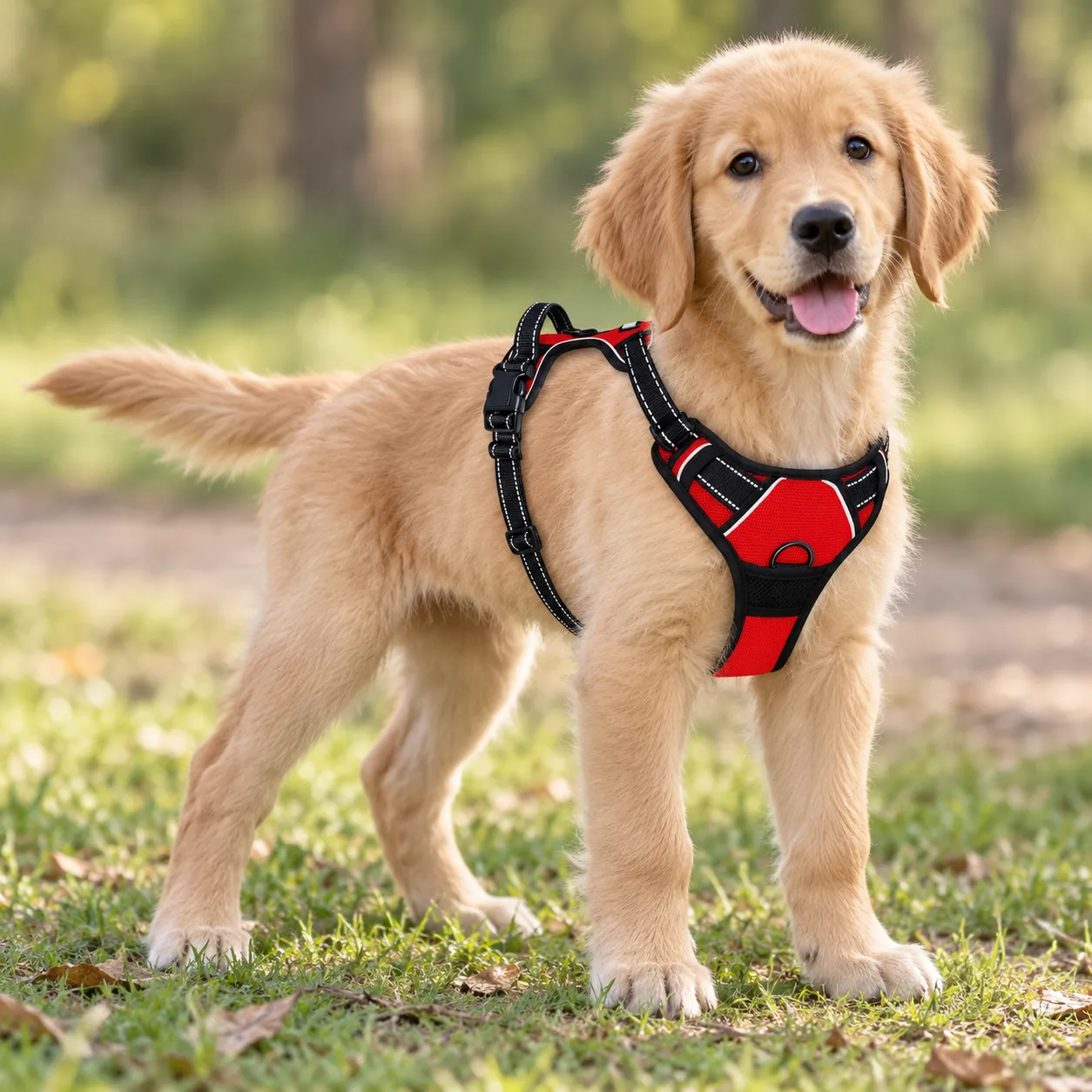
Buyer reports — one buyer bought size L for a six-month-old Golden Retriever weighing 17 kg specifically to leave growing room, and reported it fitted correctly with the first belt closed. Another fitted an Old English Bulldog puppy at fifteen weeks into size M and already expected to order larger. (verified buyer reviews)
Both of those are sensible purchases, and note what they have in common: the buyers sized to a measurement, not to a hope.
Why the attachment point matters most on a puppy
A puppy is not pulling out of stubbornness. It is learning what produces movement. If leaning forward reliably makes the walk happen, that is the lesson it takes into adulthood — and by then it weighs enough for the lesson to be a problem.
16.87 N vs 6.97 N — peak leash tension on a back-attachment harness versus a plain collar, across 52 dogs. The dogs also spent about twice as much of the walk pulling. (Shih et al., Frontiers in Veterinary Science 8:735680, 2021)
This is why we would steer you away from starting a puppy on a back-clip harness. The configuration measured as producing the most pulling is a poor place to teach a young dog what walking feels like. A chest attachment interrupts the forward lean instead of rewarding it.
82.7% — of owners report their dog pulls on the lead. (Townsend et al., cited in Johnson & Wynne, 2024)
Most dogs end up pulling. Very few owners set out to teach it. The equipment you choose in month four is part of how that happens.
Which puppy harness to choose
| Puppy | Harness | Why |
|---|---|---|
| Small breed, under 43 cm chest | Personalised vest, XS or S | Only model that reaches down to a 39 cm chest |
| Medium or large breed, 43 cm chest and up | Front-clip harness, size S or M | Chest attachment from the start |
| Large breed already past 69 cm chest | Front-clip harness, size L | See the big dog page |
The personalised vest also carries your phone number in large print on both flanks. A puppy is the dog most likely to bolt and least likely to come back when called.
Introducing the puppy harness without a fight
Put it on indoors, in short sessions, with food, before it is ever attached to a leash. Let the puppy wear it for a few minutes at a time while something good happens. A puppy that learns the harness predicts dinner will stand still to have it fitted; a puppy whose first experience of the harness is being restrained by it will fight it for months.
No measurable stress difference — in behaviour between collar-walked and harness-walked dogs across 30 pet dogs. (Grainger, Wills & Montrose, J. Vet. Behavior 11:60–64, 2016)
Worth knowing so you do not over-worry: across 30 dogs, walking on a harness produced no more stress behaviour than walking on a collar. The harness is not something to feel guilty about. It is the leash pressure and the handler's tension that a puppy reads, far more than the equipment.
When to size up
Check the fit monthly. Two flat fingers should slide under any strap; when you are down to one, re-measure. When the girth strap is at its longest setting and still snug, the harness is done. On the front-clip model, sizes overlap generously enough that most owners move S to M around four to six months on a medium breed.
Further reading: how to measure a dog, how to put a harness on, and training a dog to stop pulling.
Puppy harness questions
At what age can a puppy wear a harness?
As soon as it fits properly and the puppy can wear it comfortably indoors, which for most breeds is around eight to ten weeks. Introduce it before you attach a leash, in short sessions with food, so the first association is a good one.
Should I buy a bigger size so my puppy grows into it?
No. A loose harness is the one a frightened puppy backs out of, and that usually happens near a road. Buy for the current chest measurement and expect to buy again. On a medium or large breed, plan for two harnesses in the first year.
Is a front clip too harsh for a puppy?
No. A front attachment applies no pressure to the neck and no more force than a back clip; it just redirects rather than resisting. Grainger and colleagues (2016) found no measurable stress-behaviour difference between collar and harness walking across 30 dogs.
How often should I check the fit?
Monthly during the first year. Two flat fingers should slide under any strap. When you are down to one finger, re-measure the chest; when the girth strap is at its longest setting and still snug, it is time for the next size.