
· Nora Whitfield
What makes a no-pull harness work
The phrase “no-pull” is not regulated and describes nothing in particular. Two harnesses carrying that label can work in opposite directions, and the research shows exactly that.
The short answer
Front-attachment harnesses work, in the sense that they measurably reduce pulling. Back-attachment harnesses sold under the same words do not, and in the one trial that measured it directly, they made pulling worse than a plain collar. The label on the box is not the variable. The ring position is.
The evidence that they work
No significant difference — in pulling between a front-clip harness and a metal prong collar across 23 dogs; both beat a martingale collar at p = 0.001. (Johnson & Wynne, PeerJ 12:e18131, 2024)
Johnson and Wynne walked 23 dogs on four setups and measured pulling impulse in newton-seconds. A front-connection harness beat the martingale baseline at p = 0.001 — and matched a metal prong collar, with no significant difference between them.
That comparison is the interesting one. A prong collar is the aversive end of the leash-training spectrum. If a piece of equipment that applies no neck pressure at all performs the same, the case for the harsher tool gets considerably weaker.
The evidence that some of them do not
16.87 N vs 6.97 N — peak leash tension on a back-attachment harness versus a plain collar, across 52 dogs; time spent pulling roughly doubled (p = 0.031). (Shih et al., Frontiers in Veterinary Science 8:735680, 2021)
Shih and colleagues measured 52 shelter dogs on a neck collar and on a back-connection harness. Peak tension went from 6.97 N to 16.87 N on the harness. The dogs pulled for roughly twice as much of the walk.
The authors are careful about their own limits: the effect appeared with food as the target and disappeared with a toy. But the direction never reversed, and the result is the opposite of what a shopper assumes when they buy something labelled no-pull.
The mechanism is not mysterious. A ring between the shoulder blades gives the dog a stable point to lean into. That is the design principle of a sled harness. Putting the same geometry on a pet and printing “no pull” on the packaging does not change the physics.
Why so many owners conclude they do not work
Three reasons, and only one of them is the harness.
They bought a back clip. The commonest case, and the studies above explain the outcome.
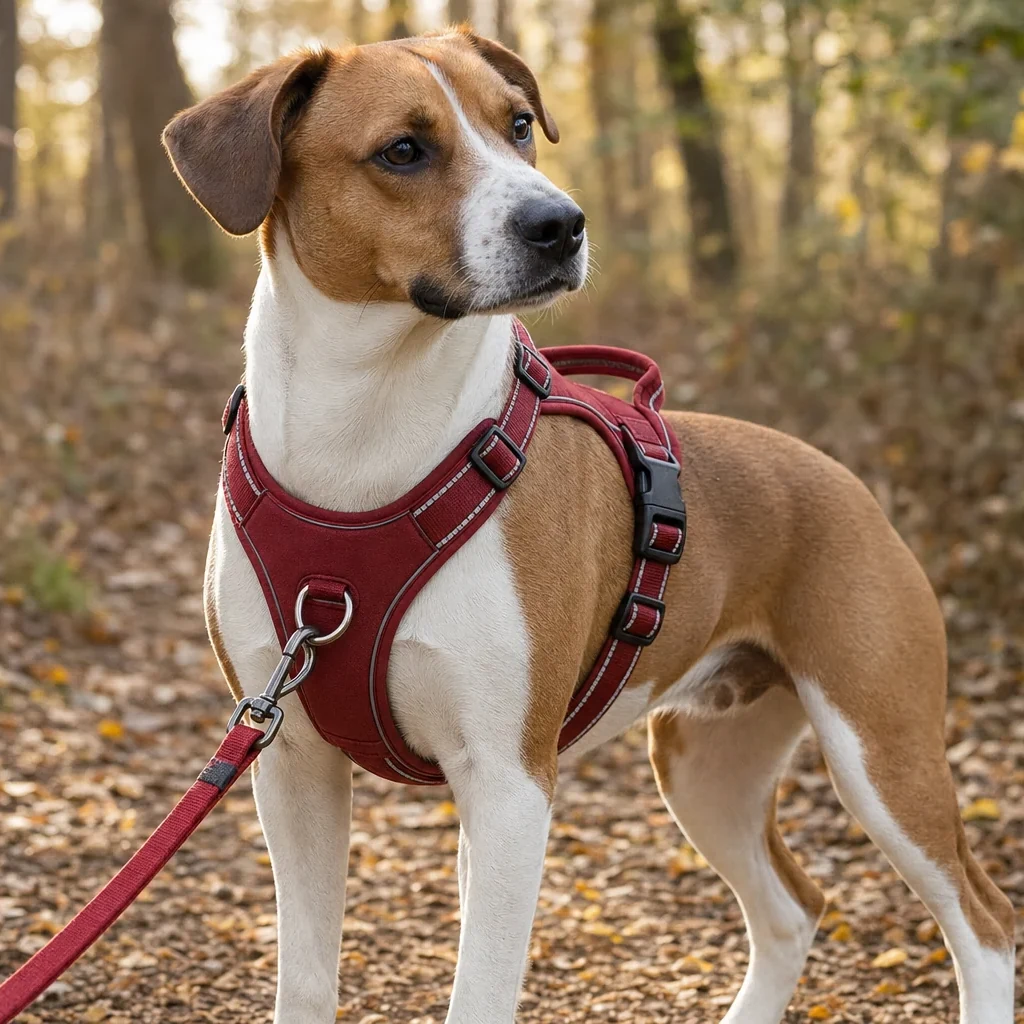
The chest panel is fitted too high. A front-clip harness with the panel up on the throat has its ring under the chin: the leash drops across the front legs and the redirection never happens. This is the origin of most “my dog trips over it” complaints. The fix is in how to put a harness on a dog.
They expected the harness to be the training. Equipment changes where force goes. It does not teach a dog what to do instead.
82.7% — of owners report that their dog pulls on the lead. (Townsend et al., cited in Johnson & Wynne, 2024)
What a harness cannot do
It cannot make pulling stop being rewarding. A dog pulls because pulling has reliably produced forward movement for its entire life. A front clip interrupts that — the dog gets turned instead of getting where it wanted — but the habit only changes if something better gets rewarded in its place. That is covered in training a dog to stop pulling.
It also cannot fix a dog that is over threshold. A dog lunging at another dog is not making a decision about leash mechanics, and no attachment point will out-argue that. That is a behaviour problem and it needs a behaviour plan.
No measurable stress difference — in behaviour between collar-walked and harness-walked dogs, across 30 pet dogs. (Grainger, Wills & Montrose, J. Vet. Behavior 11:60–64, 2016)
What a harness does not do, on the evidence, is stress the dog: across 30 dogs, harness walking produced no more stress behaviour than collar walking. The equipment choice is a mechanical decision, not an ethical crisis.
What it definitely does better than a collar
Significant rise in intraocular pressure — when leash force went through a collar, across 51 eyes of 26 dogs; no rise through a harness. (Pauli et al., JAAHA 42(3):207–211, 2006)
Whatever you conclude about pulling, a collar is the wrong place to absorb repeated force. Pauli and colleagues measured a significant rise in intraocular pressure through a collar across 51 eyes, and none through a harness. For a dog that leans into the leash daily, that is a straightforward argument for moving the load off the neck.
What the evidence supports
| Setup | Verdict on the evidence |
|---|---|
| Front-attachment harness | Yes — significantly reduced pulling, and matched a prong collar |
| Back-attachment harness | No — increased leash tension versus a plain collar |
| Flat or martingale collar | Baseline. Raises intraocular pressure under load |
| Any of them, without training | Manages the walk; does not change the habit |
If you want the mechanics in more depth, front clip versus back clip sets the two studies side by side. The harness itself is on the front-clip page.

Nora Whitfield · Leash-training specialist, Heelbrook
Nora has spent twelve years walking dogs that pull — first as a shelter volunteer, now fitting harnesses full time. She still walks two ex-shelter pullers of her own.