
· Nora Whitfield
How to stop a dog from pulling on the leash
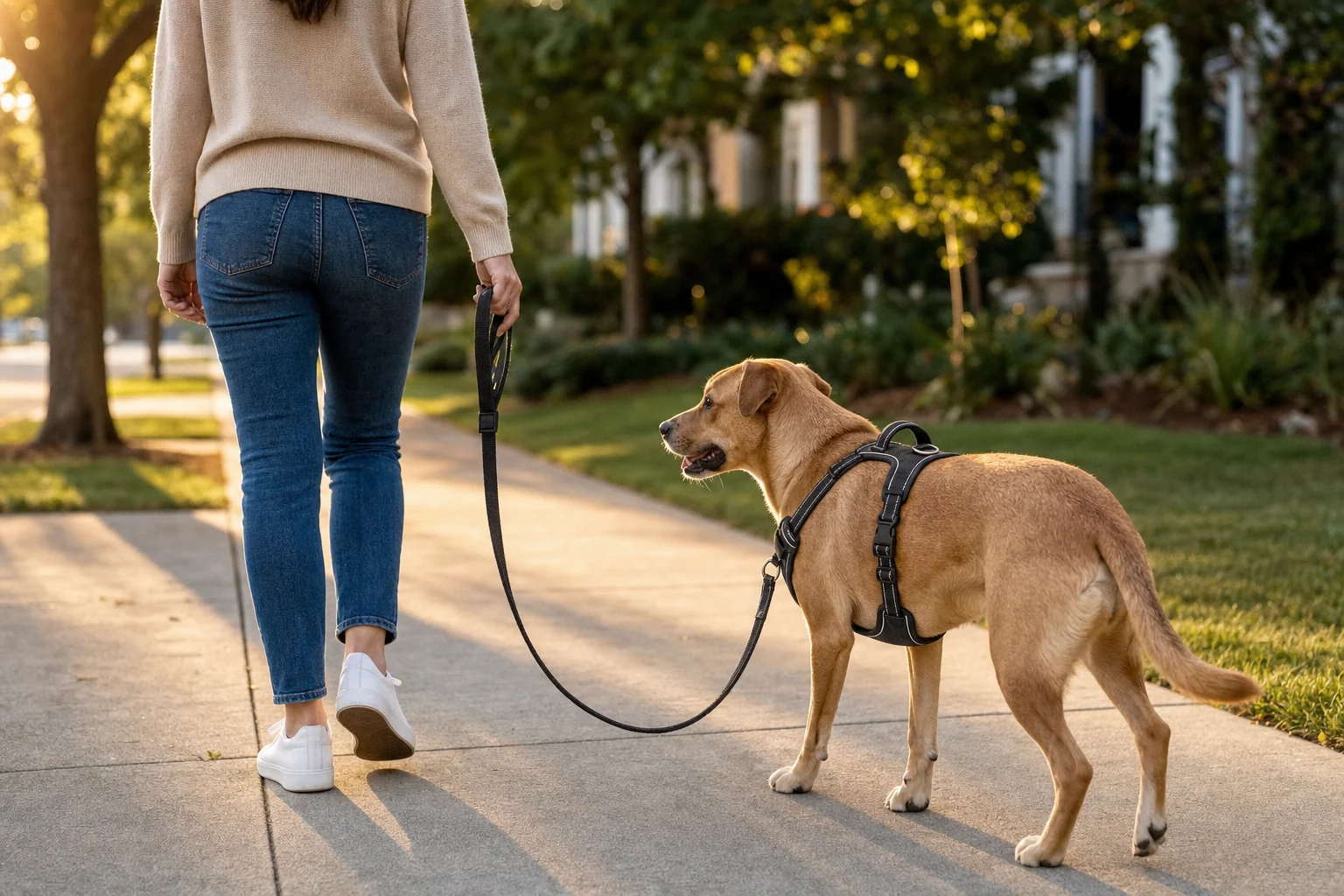
Pulling is not disobedience. It is the single most reliably rewarded behaviour in a dog's life: lean forward, and the world arrives faster. Every walk you have ever taken has paid for it.
Why your dog pulls
Because it works. A dog leans into the leash, the handler follows, and the dog reaches the lamp post. Repeat several hundred times a year from puppyhood and you have a thoroughly trained behaviour — just not the one anyone intended.
82.7% — of owners report that their dog pulls on the lead. (Townsend et al., cited in Johnson & Wynne, 2024)
Which is why this is the normal case rather than a failure. Almost nobody sets out to teach it.
The one rule everything else hangs on
A tight leash never moves forward. Not a step. The moment tension appears, you stop. The moment it disappears, you move.
That is the whole method. Everything below is about making it survivable for both of you.
How to stop your dog from pulling on the leash: the routine
Start where nothing is happening. Your hallway, then the garden, then the quiet end of your street. A dog cannot learn a new habit in the most exciting place it knows. If your first session is outside a park at 8am, you have chosen the hardest possible classroom.
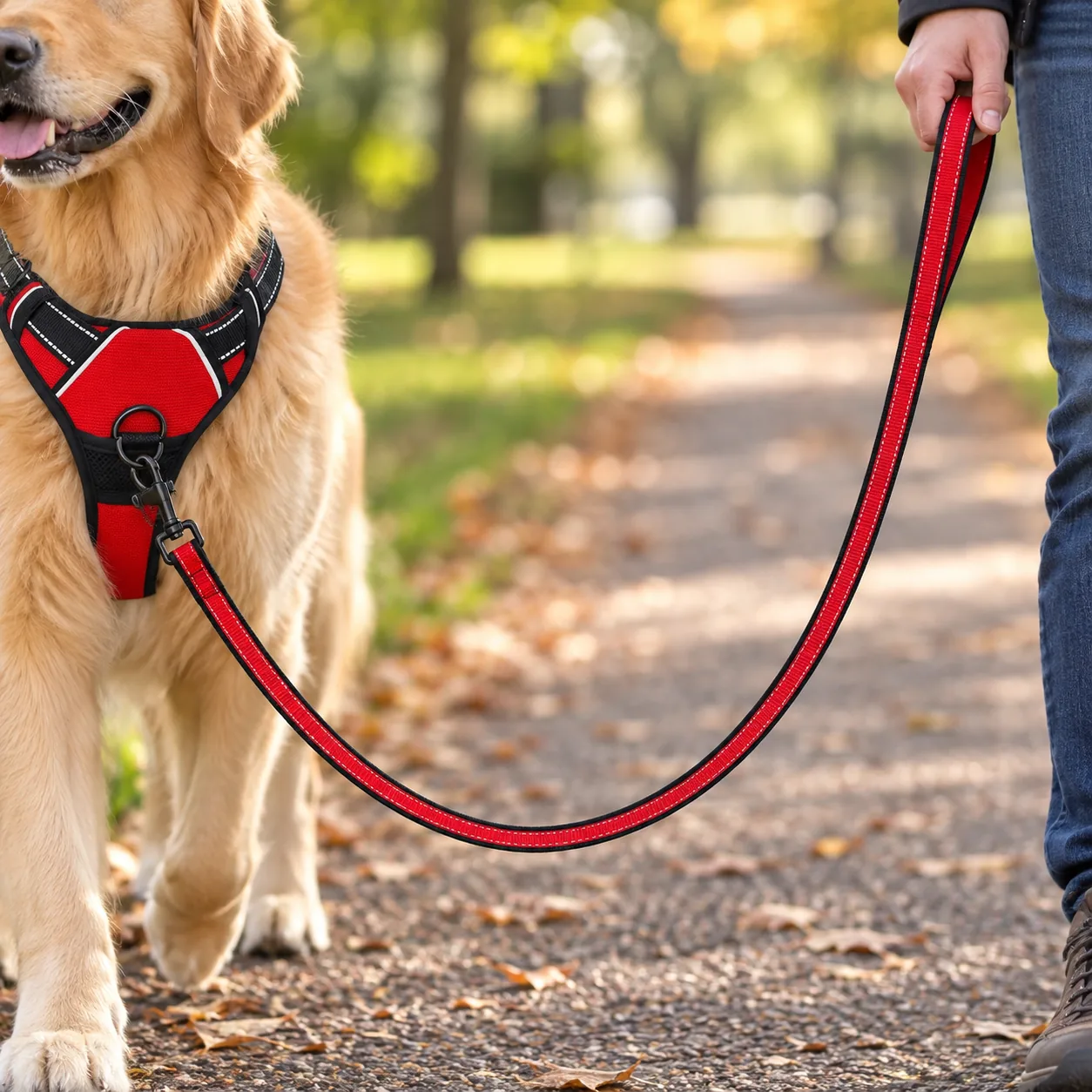
Mark the slack, not the stop. The instant the leash goes loose, say a marker word — “yes” — and feed at your leg. Timing decides everything here. Rewarding the moment the dog stops teaches stopping; rewarding the loose leash teaches the loose leash.
Feed at your knee, not out in front. Where you deliver the food is where the dog learns to be. Hold the treat out ahead and you have just taught forward.
Turn instead of tugging. When the leash tightens and stopping is not getting through, turn and walk the other way. The dog discovers that pulling produces the opposite of what it wanted. No correction required — the consequence is geometric.
Keep sessions short. Five to ten minutes of deliberate practice, then let the dog sniff on a long line as the reward. Sniffing is not the enemy of training; withholding it is what makes the walk frantic.
Where the equipment fits
Training is what changes the habit. Equipment decides whether you can practise at all.
No significant difference — in pulling between a front-clip harness and a metal prong collar across 23 dogs; both beat a martingale collar at p = 0.001. (Johnson & Wynne, PeerJ 12:e18131, 2024)
A front attachment turns a pulling dog toward you instead of giving it something to anchor against. That is what makes the stop-and-go routine workable on a strong dog — without it, standing still against a 35 kg dog is a wrestling match, not a training session.
16.87 N vs 6.97 N — peak leash tension on a back-attachment harness versus a plain collar, across 52 dogs; time spent pulling roughly doubled (p = 0.031). (Shih et al., Frontiers in Veterinary Science 8:735680, 2021)
The corollary matters just as much: if you are trying to teach loose-leash walking on a back-clip harness, you are working against the equipment. That configuration measured as producing the most pulling of any tested. The full comparison is in front clip versus back clip.
Three handler habits that keep pulling alive
| Habit | What the dog learns | Instead |
|---|---|---|
| Letting the leash stay tight “just for a bit” | Tension is normal and still moves us forward | Stop every single time, without exception |
| Rushing the first five minutes | The start of the walk is when pulling pays best | Do the deliberate practice first, while you are patient |
| Only practising on walks | This is a walk rule, not a life rule | Two minutes in the hallway, daily |
How long it takes
Weeks, not days, and it is not linear. Expect visible progress in a quiet environment within a week or two, and expect it to fall apart the first time you meet another dog. That is not regression; it is the difference between knowing a behaviour and performing it under distraction.
Rebuild by lowering the difficulty rather than raising the pressure: more distance from the trigger, quieter times of day, shorter sessions.
No measurable stress difference — in behaviour between collar-walked and harness-walked dogs, across 30 pet dogs. (Grainger, Wills & Montrose, J. Vet. Behavior 11:60–64, 2016)
And if you have been worrying that any of this stresses the dog: across 30 dogs, harness walking produced no more stress behaviour than collar walking. Calm, consistent handling is what a dog reads.
When to get help
If your dog lunges, barks or freezes at other dogs or at people, that is not a pulling problem wearing a disguise. It is a behaviour problem, and no equipment or routine on this page will resolve it. Find a qualified force-free trainer or a veterinary behaviourist.
Practical next steps: fit the harness properly with how to put a harness on a dog, check the size with how to measure a dog, and read what makes a no-pull harness work for what the equipment can and cannot carry. The harness is on the front-clip page.

Nora Whitfield · Leash-training specialist, Heelbrook
Nora has spent twelve years walking dogs that pull — first as a shelter volunteer, now fitting harnesses full time. She still walks two ex-shelter pullers of her own.